



Your Audi Blew Cold for Three Weeks After a Recharge, Then Went Warm Again
By Bavarian Performance Specialists September 15, 2026
Somebody put refrigerant in it and the vents went cold. For a while. Now, back on the 101 with the sun on the windshield, you’re getting warm air again and wondering what you paid for.
A recharge that lasts weeks instead of years means the system has a hole in it, and on Audis the hole is very often the condenser — the flat radiator-looking part sitting right behind the grille where every rock off the freeway hits first. Bavarian Performance Specialists has worked on German cars in Thousand Oaks since 1983. October is the right month to deal with this. The Conejo Valley doesn’t cool off much, and the shop diary is calmer now than it will be in June.
Quick Summary: Key Takeaways
- Refrigerant never gets consumed: if it’s low, it escaped, and a recharge without a repair is a countdown.
- The condenser is the most exposed part of the system: it lives ahead of the radiator with nothing between it and the road.
- Rock strikes and fin corrosion are the two killers: one punctures a tube, the other eats the aluminum from the outside in.
- Warm at idle, cold at speed points elsewhere: that pattern is usually airflow or a fan, not a leak.
- Salt air matters here: cars that spend time toward Malibu corrode faster than inland ones.
The Condenser Sits Where the Damage Happens
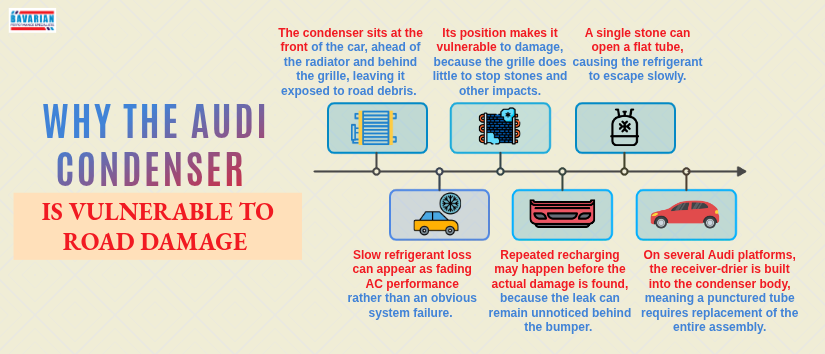
Refrigerant leaves the compressor hot and pressurized, and the condenser’s job is to shed that heat to outside air so the gas turns back into liquid. To do that it has to be first in line at the front of the car, ahead of the radiator, behind a grille that stops almost nothing.
Which is why it takes the hits. Every one of them. One stone off the 101 near Kanan Road opens a flat tube, and the loss runs slow enough that you read it as fading performance instead of a failure, which is exactly why so many of these cars get recharged twice before anybody looks behind the bumper. On several Audi platforms the receiver-drier is built into the condenser body, so a punctured tube means the whole assembly comes out rather than a patch.
Corroded Fins Fail More Quietly Than a Rock Strike
Aluminum and coastal air don’t get along. Cars that regularly run out toward Malibu and back along the coast collect salt in the condenser fins, and once corrosion works through the fin stack into a tube wall you get a pinhole leak with no impact to explain it.
The visual clue is a chalky white bloom across the front of the core, sometimes with oily residue where refrigerant oil has escaped with the gas. Oil stains are a confession. A shop light and a mirror behind the bumper cover find them in minutes.
Dye and Nitrogen Beat Guesswork Every Time
We don’t condemn a condenser on a hunch. Ever. The system gets pressure-tested with nitrogen or charged with a UV dye, then inspected at every joint, hose crimp, seal and the compressor’s shaft seal before anything gets ordered.
That matters. There are half a dozen other places an Audi loses refrigerant, and the cheap ones are worth finding first — an O-ring at a line fitting, a service port valve, a corroded aluminum line where it runs past the subframe. Replacing the wrong expensive part is the most common way this repair goes sideways.
The Conejo Valley Runs the A/C Long Past Summer
This isn’t a system you get to ignore for six months. By NOAA’s 1991 to 2020 climate normals, the nearest long-term station at Camarillo Airport averages a 76-degree high in October and 73 in November, and the first freezing night there normally doesn’t come until December 28.
So the A/C stays in service through autumn, and any leak keeps leaking. There’s a second reason not to wait: a system that runs low on refrigerant also runs low on oil, because the oil circulates with the gas. Starve a compressor long enough and a condenser bill turns into a compressor bill.
A Proper Condenser Job Includes the Recharge Details
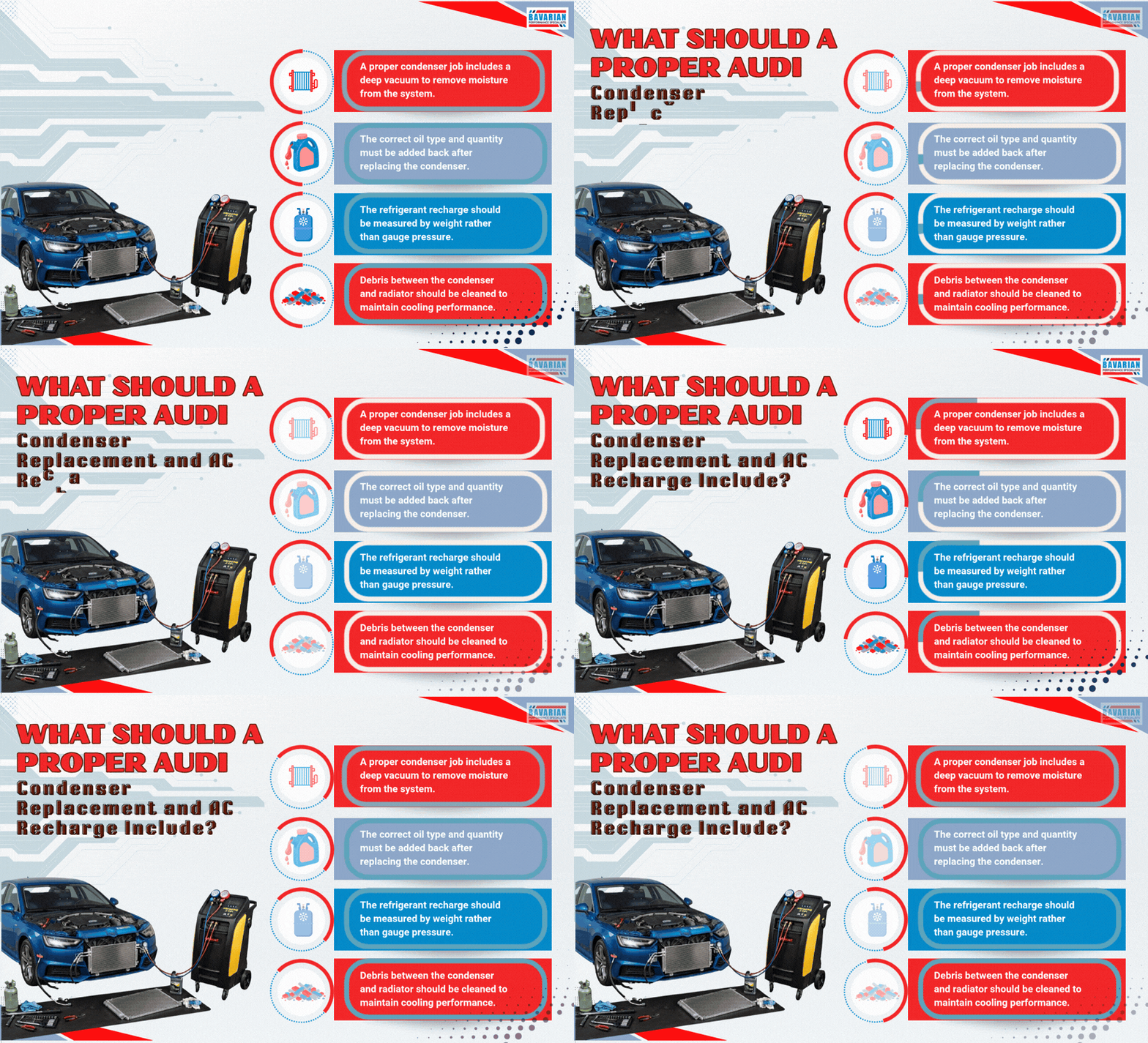
Swapping the part is the easy half. The system then needs a deep vacuum to pull moisture out, the correct oil type and quantity added back, and a recharge measured by weight rather than by gauge pressure and optimism.
We also clean the debris out from between the condenser and the radiator while the bumper is off, because a decade of leaves and bugs packed in that gap costs you cooling on both circuits. Repairs here carry a 24-month, 24,000-mile nationwide warranty, and Hal or one of the technicians will walk you through what was found before the work starts.
Frequently Asked Questions
Q: How do I know if my Audi A/C condenser is leaking?
A: Cooling that fades over weeks after a recharge, oily residue or a white chalky bloom on the front of the core, and a UV dye trace at the condenser tubes. A nitrogen pressure test confirms it before any parts get ordered.
Q: Can an A/C condenser be repaired instead of replaced?
A: Rarely worth it. The tubes are thin aluminum, the core is often bonded to a built-in receiver-drier, and a repaired tube tends to fail again next to the patch. Replacement is the honest answer on most Audis.
Q: Why is my Audi A/C cold on the freeway and warm in traffic?
A: That points at airflow rather than a leak — a cooling fan that isn’t running, or a condenser packed with road debris. At speed you get ram air through the grille; at a standstill you only get what the fan pulls.
Q: How long does refrigerant last in a healthy Audi?
A: Years. A sealed system loses a very small amount over time, which is why a car that needs topping up every season has a leak worth finding rather than a maintenance item.
Get It Diagnosed Before the Next Recharge
If a shop has already put refrigerant in it once this year, tell us when and how long the cold lasted. That timeline narrows the leak size before we even open the hood.
Bavarian Performance Specialists, 3121 Thousand Oaks Blvd #1, Thousand Oaks, CA 91362. Open Monday through Friday, opening at 8:00 AM. Online at beemerpros.com.
