


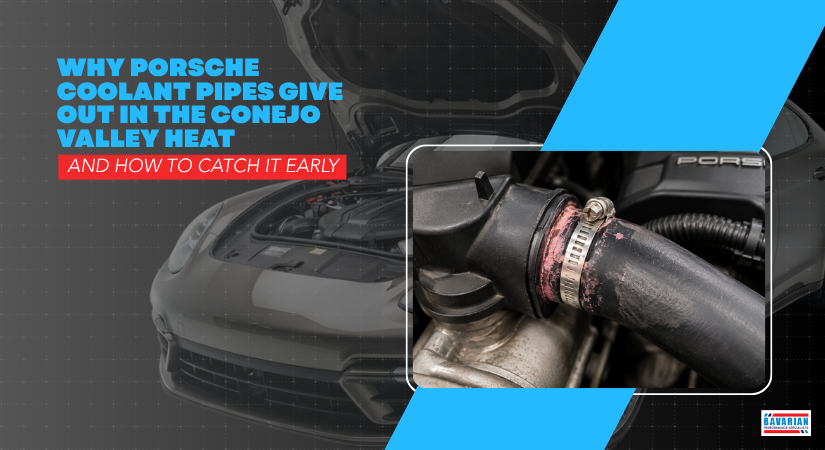
Why Porsche Coolant Pipes Give Out in the Conejo Valley Heat — And How to Catch It Early
By Bavarian Performance Specialists July 24, 2026
The Conejo Valley bakes in summer. Push a Porsche up the 101 grade past Newbury Park on a 95-degree afternoon, or just let it heat-soak in a Thousand Oaks parking lot all day, and the cooling system takes the hit. On the V8 Cayenne and Panamera, the coolant pipes are a known weak point, and heat is what finishes them off.
A pipe failure doesn’t always announce itself. Sometimes it’s a sweet smell and a small drip. Sometimes it’s a temperature gauge climbing fast on the freeway with no warning at all. Either way, an overheating Porsche is not something to drive on, and catching it early is the gap between a manageable repair and a cracked head.
Quick Summary: Key Takeaways
- Heat is the trigger: Conejo Valley summer temperatures speed up the failure of aging Porsche coolant pipes and fittings.
- The V8 pipes are the classic case: Original plastic and glued pipes on Cayenne and Panamera V8s crack and let go under heat and pressure.
- Watch for coolant loss: A sweet smell, a low reservoir, or a puddle means the system is leaking — don’t top it off and forget it.
- Don’t drive it hot: A leaking pipe is cheap next to the warped head an overheated engine can cause.
- A pressure test finds it: We locate the leak instead of guessing, then fix what actually failed.
What a Coolant Pipe Failure Actually Looks Like on a Porsche
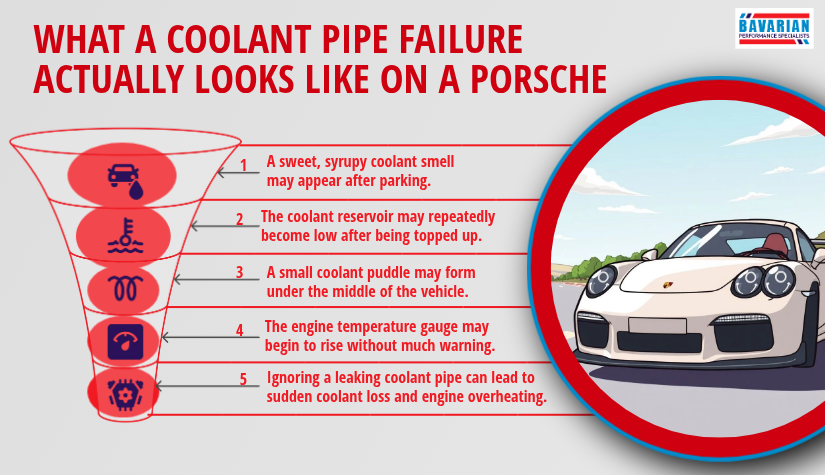
It usually shows up as coolant where it shouldn’t be. You might catch a sweet, syrupy smell after parking in the driveway, or find the reservoir low again a week after you topped it, or spot a small puddle under the middle of the car. Some owners get no warning at all until the needle climbs on the 101.
Timing decides the bill. Caught early, a weeping pipe is a straightforward repair. Ignored until it blows on a hot freeway run, that same pipe can dump its coolant in seconds and cook the engine before you ever reach an off-ramp. So don’t wait it out.
Why the Conejo Valley Heat Is So Hard on These Pipes
Blame the plastic. Porsche cooling systems push a lot of pressurized hot coolant through pipes and fittings crammed into a hot engine bay, and on the 4.8-liter V8 Cayenne and Panamera the factory used plastic pipes with glued or crimped joints that turn brittle over years of heat cycling in a climate like ours.
Then you add load. Climbing the grade toward the Conejo summit with the A/C running raises coolant temperature and pressure at the exact moment the pipes are weakest. Old plastic, high heat, sustained pressure. That combination is what makes these pipes let go in the middle of summer instead of on a mild spring morning.
The Coolant Crossover and Water Pump Are on the Same Watch List
Pipes aren’t the only casualty. The water pump impeller, the thermostat, and the plastic coolant distribution housing all wear on a similar clock, and one weak part quietly loads up the next — a tired water pump moves less coolant, temperatures climb higher, and an aging pipe joint sees more stress than it was ever built to take.
So we look at the whole system. When a V8 Porsche comes in leaking coolant, we check the pump, the thermostat, the reservoir cap, and the pipes together, because fixing one leak while a failing pump sits behind it just means you’re back on our lift next month. Do it once.
Why You Never Limp an Overheating Porsche Home
Heat destroys engines, not distance. When a coolant pipe fails and temperatures spike, aluminum heads warp and gaskets give up in minutes, and a pipe repair — real money on its own — is still a fraction of what a warped cylinder head or a scored engine costs on a Porsche V8.
So don’t gamble it. If the gauge climbs into the red or you see steam, pull over, shut it off, and call a tow. AAA expected to rescue 7.7 million drivers over summer 2025, and an overheated cooling system is one of the most common reasons a car ends up on a flatbed.
How We Diagnose and Fix a Porsche Cooling Leak in Thousand Oaks
We start with a pressure test. Not a guess. That, plus the right diagnostic tools, tells us whether you’re losing coolant at a pipe, a housing, the pump, or a hose, and on the V8 cars many owners take the chance to upgrade the failure-prone plastic crossover pipes to the aluminum revision so the same repair doesn’t repeat.
From there we replace what failed, refill with the correct Porsche coolant, and bleed the system properly so no trapped air pocket creates a hot spot down the road. Every qualifying repair carries our 24-month/24,000-mile nationwide warranty. And you get a straight explanation of exactly what we found.

Why Conejo Valley Porsche Owners Bring Their Cars to Hal’s Team
We know these cars. We’ve serviced German and European vehicles on Thousand Oaks Boulevard since 1983, owner Hal and the team run factory-grade diagnostics, we use the correct parts, and we won’t sell you a repair you don’t need — which is why drivers from Newbury Park, Westlake Village, Agoura Hills, and Malibu keep coming back.
That’s how the shop keeps winning “Best Mechanics in Town.” Straight answers. Real diagnosis. Dealer-level tools. Bring the Porsche in before summer finds the weak pipe for you.
Frequently Asked Questions
Q: Why do Porsche coolant pipes fail?
A: It comes down to old plastic. On V8 Cayenne and Panamera models the original coolant pipes use plastic with glued or crimped joints that grow brittle over years of heat cycling and finally crack under pressure, and sustained high underhood temperatures like a Conejo Valley summer speed that aging up, which is why the pipes tend to let go in hot weather.
Q: What are the signs of a coolant leak on a Porsche?
A: Watch for a few things. A sweet coolant smell after parking, a reservoir that keeps dropping, a puddle under the center of the car, or a temperature gauge that climbs on the freeway all mean the sealed cooling system is losing coolant and should be pressure-tested before you drive the car hard again.
Q: Is it safe to drive a Porsche that’s running hot?
A: No. If the gauge climbs into the red or you see steam, pull over, shut the engine off, and have it towed, because driving an overheating Porsche can warp the cylinder heads and blow head gaskets, turning a coolant-pipe repair into a far more expensive engine job.
Q: Should I upgrade my Porsche coolant pipes to aluminum?
A: Often, yes. On the V8 Cayenne and Panamera many owners replace the failure-prone plastic crossover pipes with the aluminum revision during the repair so the same failure doesn’t return, and whether it’s worth it depends on your model and mileage — we’ll give you a clear recommendation after inspecting the car.
Get Your Porsche’s Cooling System Checked Before the Next Heat Wave
Smelling coolant or watching the gauge creep up? Bring your Porsche in before a pipe lets go on the 101.
Bavarian Performance Specialists — 3121 Thousand Oaks Blvd #1, Thousand Oaks, CA 91362
Hours: Mon–Fri 8:00 AM – 5:30 PM; Sat–Sun closed
Website: beemerpros.com
