



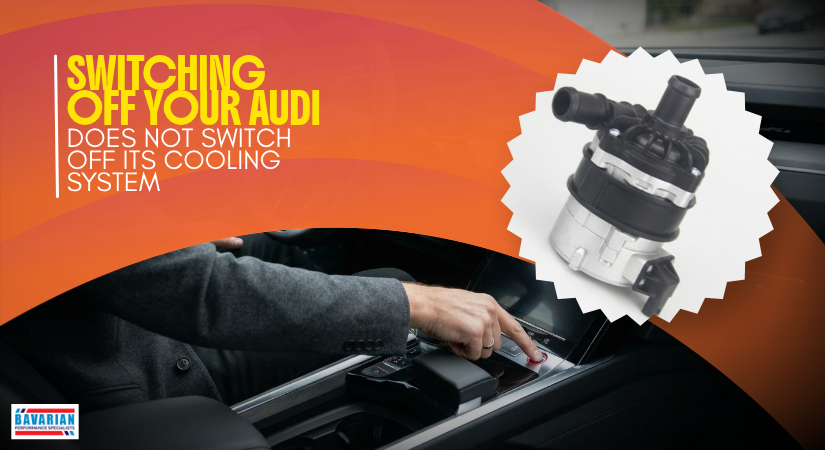
Switching Off Your Audi Does Not Switch Off Its Cooling System
By Bavarian Performance Specialists November 21, 2026
Most drivers assume the engine stops when the key comes out. On a turbocharged Audi it does not, or at least the cooling system does not. For a few minutes after shutdown a small electric pump keeps coolant moving through the turbocharger and the cylinder head, and the radiator fan may run with it. Thousand Oaks owners hear that in the garage and occasionally mistake it for a fault. Trouble starts when the sound stops, because the part making it is a consumable and nobody tells you when it has quit.
The pump that works after you park
A turbocharger sits in the exhaust stream. Its bearing housing is cooled by engine coolant and lubricated by engine oil, and both only circulate while the engine is turning. Shut the engine off at operating temperature and the turbo is still radiating heat into a system with no flow in it.
Without help, the coolant sitting inside the turbo housing cooks. The NIST Chemistry WebBook gives ethylene glycol a boiling point of 470.5 K, or roughly 387 degrees Fahrenheit. A turbine housing’s hot side goes well past that on a hard pull up the 23. The oil in the bearing journals has the same problem. It bakes onto the shaft as hard carbon, and that carbon is what eventually destroys the bearing.
So Audi fitted an auxiliary electric coolant pump, sometimes called the after-run pump, with its own relay and its own control logic. The engine control module decides, based on coolant temperature and how hard you were driving, whether to run it and for how long. It circulates coolant through the turbo and head for a few minutes and carries the heat out to the radiator. Then it stops. Nothing you do as a driver triggers it and nothing you do turns it off.
The same strategy appears on plenty of Audi and Volkswagen engines in various forms, and most owners go the life of the car without knowing the part exists.
What you actually notice when it stops working
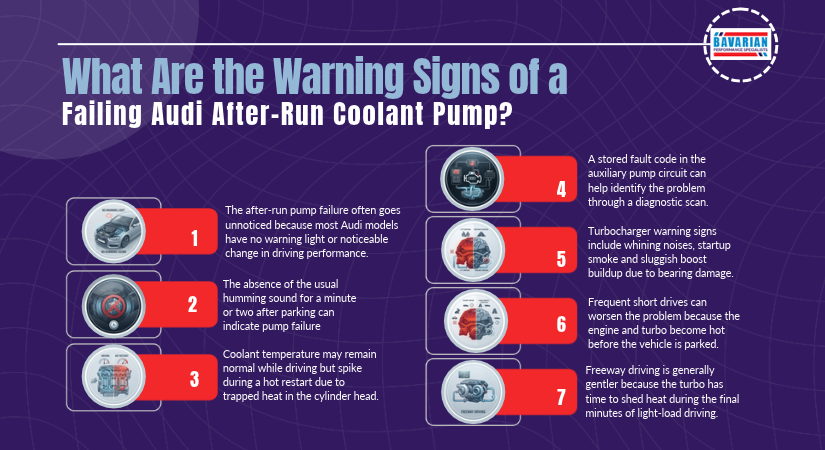
Almost nothing, and that is the problem. There is no warning light for an after-run pump on most models and no change in how the car drives. The failure is silent and the damage accumulates over months.
Three things do give it away. The first is the absence of the sound — if your Audi used to murmur for a minute or two after you parked and now goes dead quiet, have it scanned. The second is a coolant temperature that reads normal while driving but spikes on a hot restart, because the heat that should have been carried away after the last shutdown is still sitting in the head. The third is a stored fault code for the auxiliary pump circuit, and you will only see that if someone scans the car.
There is a fourth sign and it is the expensive one: a turbo that has started to whine, smoke on startup, or feel lazy building boost. By then the bearing has already suffered, and replacing the pump afterward fixes the cause without undoing the damage.
Short drives make the whole thing worse. A run from Newbury Park to Westlake Village gets everything hot and then parks it. An after-run pump is designed around exactly that duty cycle. Freeway driving, oddly, is gentler, because you spend the last few minutes at light load and the turbo is already shedding heat before you stop.
None of this is something you can hear from the driver’s seat while the car is running, so a scan tells you more here than a road test does.
Testing it, and what replacement involves
Testing is straightforward and it does not take long. We scan for stored codes in the engine module, then command the pump on directly with a scan tool and listen for it. A pump that will not run on command is either seized, open-circuit, or being starved by a failed relay, and the three are easy to tell apart with a meter.
The pump itself is a small part. On most Audi engines it lives low on the engine or behind the front bumper structure, and getting to it is where the labor goes. Access varies enormously between models, so a quote without a look under the car is a guess.
Two things go in alongside it. The relay, because it is cheap, it is part of the same circuit, and a relay that has been switching a dying pump has usually suffered for it. And the small coolant lines running to the turbo, because they are aged rubber in the hottest part of the engine bay and they are already apart.
The system gets vacuum-filled afterward, since pouring leaves an air pocket in the turbo coolant line and that defeats the whole purpose of the repair, and then it goes on a road test long enough to get the engine fully hot so we can confirm the pump cycles on shutdown.
Frequently Asked Questions
Q: How long should the coolant pump run after I turn my Audi off?
A: Anywhere from under a minute to several minutes, depending on how hot the engine was when you parked. After a gentle drive it may not run at all. That variation is normal and is decided by the engine control module.
Q: Can I just let the engine idle before shutting it down instead?
A: Idling does cool the turbo somewhat, but it also keeps making exhaust heat, and it is a poor substitute for a pump that circulates coolant with the engine off. If the pump has failed, replace it.
Q: Is the after-run pump the same as the main water pump?
A: No. The main water pump is driven by the engine and only works while the engine is running. The after-run pump is electric, much smaller, and exists specifically to move coolant when the engine is not turning.
A Scan and a Bench Test Will Settle It
If your Audi has gone quiet after shutdown, a scan and a bench test will settle it in minutes.
Bavarian Performance Specialists — 3121 Thousand Oaks Blvd #1, Thousand Oaks, CA 91362
